
Belmont Weekly Blotter Sources
The Belmont County sheriff's office publishes no weekly booking report and keeps no public arrest archive. A multi-day log leans on two sources. The sheriff's official New Inmate Roster supplies current custody and booking fields. Dated local news fills the gaps. The two overlap only partly. A police report may describe a complaint, a traffic stop, or a citation with no admission to Belmont County Jail behind it. Roster names can draw no news coverage at all. Keep the publisher, event date, arresting agency, and custody status separate, and the log stays honest.
Belmont Police Reports by Date
Two local outlets carry the dated material. The Times Leader's recurring Police Reports digests incidents drawn from police and sheriff information. Times, places, calls, stops, charges, and agencies all appear. No fixed daily release schedule applies. Barnesville Area News publishes Belmont County Sheriff's Log excerpts spanning multiple days. Its entries lean toward western Belmont County and read like a running action list. Treat them as reporting, not an official feed. They form no booking table and no mugshot gallery.
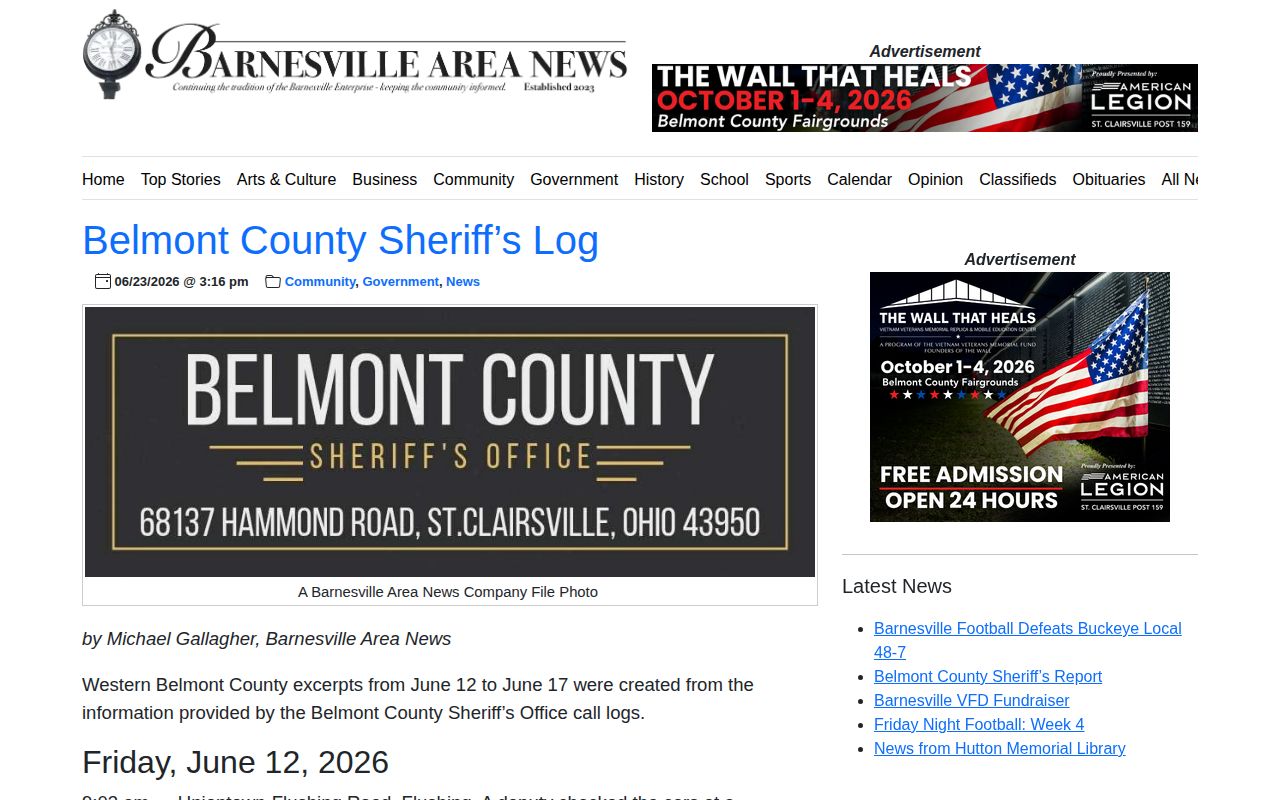
The Times Leader column displays the narrative log format. Match its dates to incidents, then pull the official arrest record from the sheriff or court.
Read Belmont Logs Carefully
Every claim in a blotter belongs to its channel. Work backward through publication dates. Read the date inside each entry as well. A Monday column may summarize Friday, Saturday, and Sunday events.
- Choose a date range that spans the days of interest, including the next publication day after a weekend or holiday.
- Record the event date, time, place, named agency, and whether the item actually says a person was arrested or booked.
- Open the sheriff roster to determine whether a named person is represented in current county custody.
- Use the arresting-agency field to connect a county booking with Martins Ferry, St. Clairsville, Barnesville, the sheriff, or another authority.
- Check CourtView eAccess for filed charges, hearings, and later disposition when a case exists.
Need only the newest 24 hours? Switch to the Daily Arrest Report. That page tracks same-day bookings, while the weekly method weighs chronology, delayed publication, and archive retrieval.
What Belmont Blotter Entries Show
A police-report item and a jail booking row use different fields. Blotter columns log calls. Roster rows log custody, booking dates, and charges, so the two formats should never be confused.
| Field or clue | Multi-day meaning |
|---|---|
| Publication and post date | When the newspaper placed the digest online, which may follow the event. |
| Incident date, time, and place | Chronology from the reported log; it does not by itself prove a jail admission. |
| Agency and action | Identifies who responded and whether the entry says arrest, citation, report, or investigation. |
| Name and alleged offense | May be included when reported; the charge remains subject to court review. |
| Roster Book Date and Jail ID | Official current-custody identifiers available only if a corresponding jail row exists. |
| Court and disposition | The roster can point to a court, but final case results belong in the court docket. |
Charges listed at booking can change as a case moves through court. Disposition means the eventual court resolution. A roster's current-disposition label shifts as cases progress. Check any label against the county clerk's record before relying on it.
Weekend Belmont Arrest Reports
Neither the sheriff roster nor the news columns follow a fixed weekend posting schedule. Processing and publication run on different clocks. An incident late Saturday can land in a later digest. A booking appears only at the roster's next update. Resist calling any delay a weekend surge. A catch-up pattern is possible. A measured rise in arrests is a different claim. Stretch the date range through the next regular news edition and compare it with the roster. For urgent custody questions, call Belmont County Jail at 740-695-5124 instead of waiting on the next article. The official jail description explains the booking pipeline. Belmont County Jail serves the sheriff, county police departments, and federal agencies. That is why a city incident can surface later as a county booking. Not every city police contact ends in jail.
Belmont Sheriff Reports in Context
The Times Leader sheriff column adds another dated view of activity.
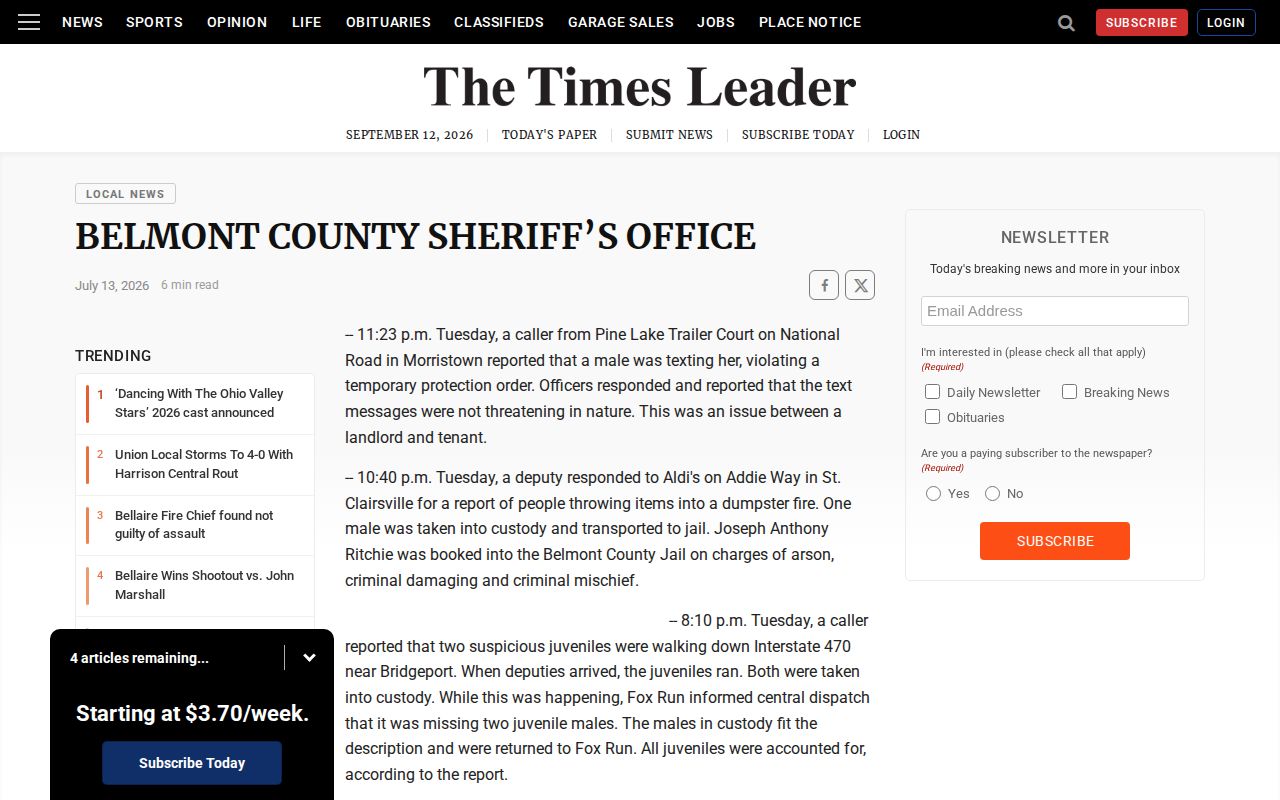
The column works as a chronology source. It is no booking roster, no mugshot feed. Other outlets pitch in with event stories. The Intelligencer runs recurring police-report coverage. Lede News publishes individual sheriff arrest stories. Cadence and access can shift, so treat news as secondary and start with official sources.
Why Belmont Logs Mix Events
Enforcement numbers and jail bookings answer different questions. The Ohio State Highway Patrol's 2023 annual operational report counts Belmont County traffic stops, impaired-driving activity, violence-related activity, and warrant or wanted activity. Those figures describe police work on the roads. They are not Belmont County Jail bookings. A multi-day police blotter can therefore mix road events, warrant actions, and other calls, which is why the events look jumbled. Never swap an enforcement count for an arrest-log total. One event can produce several measures. Another agency's arrest may still be booked at the county jail. The clean method separates the three tools. Use a blotter for dated incident context. Use a roster for current county custody. Use the court docket for the continuing case. For custody notifications after a confirmed booking, the VINELink Inmate Check is a separate channel that can support release or transfer alerts, but it cannot turn a newspaper item into a verified custody record.
Older Belmont Arrest Records
Older Belmont County arrest records call for a different route. The sheriff's live roster is not a historical archive. Once a row disappears, the county's official retention schedule supplies the firmer path. Schedule S19-84 keeps an inmate booking record for 25 years after final release. It covers name, aliases, physical descriptors, charges or commitment, booking date, release date, booking photo, arresting agency, and admittance information. That term governs agency retention, not public web display. Other files follow other clocks. Obsolete arrest cards run 50 years with transfer to archives. Incident and non-criminal reports last four years. Offense reports run 15 years. Misdemeanor offense reports last at least five years or through the limitations period. Juvenile records sit under separate restrictions. One event can thus have several retention rules. Start an older booking inquiry at the sheriff's public-records page. Give the full name, a booking or release date range, the agency, and the S19-84 booking-record series. If the sheriff says a record transferred, ask for its archival custodian and reference. The Belmont County Records Center and Archives manages storage and preservation for county departments. It offers no public booking-photo index.
Request a Belmont Log Record
A narrow request beats asking the sheriff to build a custom weekly arrest list. Ask for an existing inmate booking record, arrest report, or offense report. Tie it to a name, a date range, and the arresting agency. Want a booking photograph? Select "Other" on the sheriff form. State that the non-exempt booking record and booking image are requested. Fees are modest. The sheriff's page lists email delivery and black-and-white copies at $0.10 per single-sided page. Color runs $0.20, CD or DVD $1, approved USB media at a capacity-based cost, and mail with postage added. Staff contact a requester within three business days. If the web form fails, keep the printable form, mail, phone, and in-person paths ready. A city department may hold the incident report. The sheriff may hold the jail booking. Use the arresting-agency field to route that request. The countywide recent-arrests hub explains those city and county record boundaries. It also covers official mugshot and warrant channels. No paid photo-removal service is linked or endorsed.
Public Record Search
Sponsored Results